Governor Babajide Sanwo-Olu, on Friday, appealed to individuals and organisations to support the government’s efforts to sustain the security of lives and property in the state through the Lagos State Security Trust Fund (LSSTF).
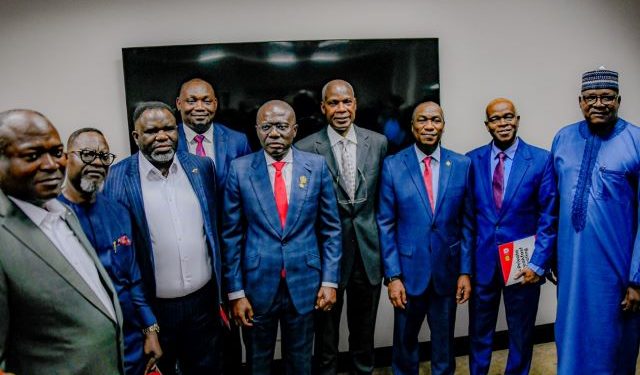
Sanwo-Olu made the appeal during a private breakfast meeting with selected Managing Directors and Chief Executive Officers of various companies, organised by the LSSTF in the Ikoyi area of Lagos, to raise funds for critical security needs for 2026.
The governor said past interventions had been effectively utilised by the LSSTF to empower security agencies and ensure a safe and secure environment, noting that the model had since been adopted by other subnational and federal governments.
He said: “On a year-on-year basis, the Lagos State Government has never taken a back seat in its responsibility. We still fund well over 50 per cent of what happens annually. However, we wanted a system that the private sector can trust—one where they can see that their support is always judiciously used. There is accountability, and the funds are transparently deployed at all times.
“We are rebuilding the Command and Control Centre with state-of-the-art equipment. We are installing CCTV cameras. We started with a Safe City model and initially planned to deploy between 5,000 and 10,000 cameras across Lagos. We have not gone as far as we intended, and we want to scale it up.
“We want to ensure that Lagos continues to remain secure. We also want to improve the rescue capacity, capability, and response time of our first responders.”
Some of the identified security needs include multi-purpose security helicopters and drones, Armoured Personnel Carriers (APCs), water cannons, tactical training and infrastructural upgrades for the police, digital communication equipment, smart CCTV cameras, operational vehicles, and an ultra-modern mechanical workshop, among others.
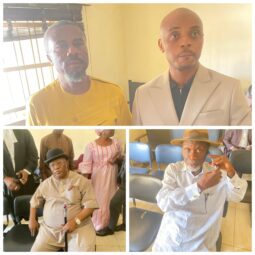
Commenting on recent demonstrations by some protesters against demolitions in parts of Makoko, Governor Sanwo-Olu said the actions of the government were taken in the public interest.
He said: “I have been accused of destroying Makoko. You will notice shanties sprawling near the Third Mainland Bridge. The challenge was that the settlement was expanding at an incredible speed and getting dangerously close to the bridge.
“There are also high-tension power lines underneath the area. I am not going to sit back and allow a situation where something collapses and, in one day, between 100 and 500 people lose their lives.
“What we did was to push them back. For six years, a United Nations agency claimed it would support development if I provided funding. I told them I was ready to provide my own funds. They have not returned to date. Just last week, they admitted they no longer had the money.
“People often tell stories. Of what benefit would it be for the government to dislocate people? It can only be in the interest of their safety. We will not sit back, allow disasters to happen, and then be blamed for inaction.
“We understand our responsibility and what we are meant to do. Sometimes, you see NGOs collecting thousands of dollars from donor countries, making videos of two or three children and saying, ‘You miss school today, you miss school tomorrow,’ all for pecuniary gain. It is a shame.
“I want people to be assured that we are not taking anything away from anyone; we are simply trying to make life better for our people.”
The governor also disclosed plans by his administration to commission 35 schools accommodating about 22,000 students in the Tolu community of Ajegunle. He further spoke on how his administration resolved the long-standing Okobaba sawmill issue.
He said: “Okobaba was a place that experienced fire outbreaks almost every year. We addressed it. It took between 10 and 15 years, but we successfully relocated the operators to Agbowa. It cost the government billions of naira, and we built over 500 houses for them. That is why they are no longer there.
“Next month, I will commission 35 junior and senior secondary schools with capacity for over 22,000 students in Tolu, Ajegunle. We are dealing with many challenges, but through all of this, we must continue to keep our people safe.
“We also need to create an environment that attracts and sustains investment. We must assure new and existing investors that Lagos remains the right place for business and that the future is secure.”