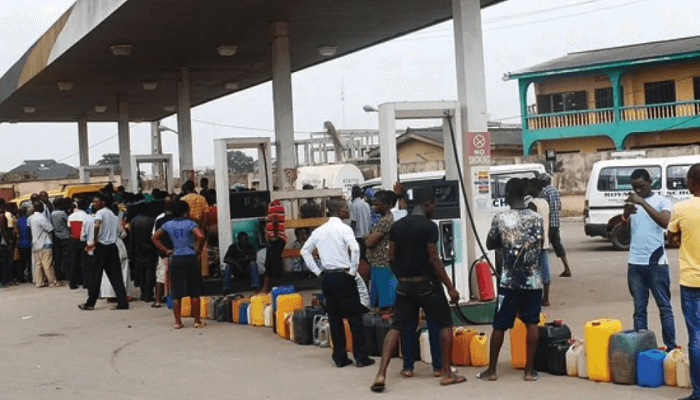
Long queues are beginning to build up at MRS filling stations where Premium Motor Spirit (PMS), also known as petrol, is sold below ₦1,000 per litre, as consumers rush in search of cheaper fuel.
A market survey conducted on Saturday morning revealed that private car owners and commercial bus drivers are starting to form long lines at MRS stations, especially along the Ibadan–Lagos Expressway, where petrol is currently sold at ₦937 per litre.
Other stations along the same axis, however, do not have as many queues as the MRS station at Alapere, as most have increased pump prices above ₦1,000.
While Eterna Plc has hiked its price to ₦1,040 per litre, North West Capital Oil and Fatgbems have also adjusted their prices to ₦1,030 per litre, with Mobil stations selling slightly lower at ₦1,025 per litre.
Despite the rush for petrol, a few stations, including those operated by the Nigerian National Petroleum Company (NNPC) Limited, have shut their gates against buyers.
The state oil company’s station at OPIC Estate remained shut as of 7:00 a.m. on Saturday. It could not be ascertained whether the closure was due to product shortages or other reasons.
Also, some TotalEnergies stations along the expressway were not selling fuel as of the time of filing this report, while others recorded only a few buyers waiting at their gates.
The development followed a sharp surge in global crude oil prices above the $80 per barrel threshold earlier in the week.
Reports emerged on Tuesday that Dangote Petroleum Refinery & Petrochemicals had increased the ex-depot price of petrol from ₦774 to ₦874 per litre, representing a ₦100 hike.
Dangote’s price hike followed a warning on Monday by economist Paul Alaje that petrol prices in Nigeria could climb to about ₦1,000 per litre if the ongoing conflict involving the United States, Israel, and Iran was not effectively managed.
Alaje, who is the Chief Economist at SPM Professionals, spoke on Channels Television’s Politics Today amid escalating geopolitical tensions in the Middle East.
According to him, increases in crude oil prices typically translate into higher costs for refined petroleum products such as petrol, diesel, and aviation fuel, with wide implications for businesses and households.
“While crude oil goes up, we all need to check the impact on our economy. The first thing you see is high inflation, because as crude oil rises, the cost of PMS, diesel, and Jet-A1 will also follow.
“As that is going on, about nine per cent has already been added to the cost of PMS in Nigeria, and by the end of April, we project that if the war is not properly managed, it might rise to ₦1,000 or more for PMS in Nigeria.
“If PMS is ₦1,000, you can imagine what diesel will be; you can imagine what flight tickets will be. It will affect the poor, the middle class and, of course, the rich,” the economist said.
Oil prices surged during the week as investors monitored developments in the Middle East, where the United States and Israel continued to bombard Iran while Tehran launched further strikes on neighbouring countries.
The attacks on the Islamic Republic have disrupted regional energy flows, with the crucial Strait of Hormuz — through which about a fifth of global oil passes — effectively closed off. The conflict has also fuelled fears of a fresh energy crisis that could further drive inflation.
Market movements, however, have remained comparatively mild amid hopes that the crisis will be short-lived and will not cause major disruption to the global economy.
But analysts warn that the longer the conflict persists, the more damaging it could become for the global economy as supply chains are disrupted and prices surge.
Iran has responded by launching missiles and drones across the Middle East, including in Lebanon, Saudi Arabia, Qatar, and Dubai, while explicitly threatening to drive up global energy costs.
This pushed oil prices up nearly 14 per cent on Monday before slightly easing, while European natural gas prices spiked by almost 40 per cent after Qatar’s state-run energy firm announced it had halted liquefied natural gas production.
Meanwhile, a general in Iran’s Revolutionary Guards threatened to “burn any ship” attempting to navigate the Strait of Hormuz.
“We will also attack oil pipelines and will not allow a single drop of oil to leave the region. Oil prices will reach $200 in the coming days,” he warned.
Crude prices also rose by at least two per cent on Tuesday, as analysts say the rise in energy costs could pose a challenge for central bankers trying to bring down inflation while also cutting interest rates to support their economies.